Showing posts with label Robert W. Chambers. Show all posts

Sunday, January 5, 2014

An Inhabitant of Carcosa by Ambrose Bierce

According to sources I have checked, the fictional place Carcosa, in this story by Ambrose Bierce, was a place of inspiration for author Robert W. Chambers' work The King in Yellow which also mentions the ancient city of Carsosa, and, in turn, is also used as a setting in H.P. Lovecraft stories.


AN INHABITANT OF CARCOSA

by

Ambrose G. Bierce

For there be divers sorts of death -- some wherein the body remaineth; and in some it vanisheth quite away with the spirit. This commonly occurreth only in solitude (such is God's will) and, none seeing the end, we say the man is lost, or gone on a long journey -- which indeed he hath; but sometimes it hath happened in sight of many, as abundant testimony showeth. In one kind of death the spirit also dieth, and this it hath been known to do while yet the body was in vigor for many years. Sometimes, as is veritably attested, it dieth with the body, but after a season is raised up again in that place where the body did decay.
Pondering these words of Hali (whom God rest) and questioning their full meaning, as one who, having an intimation, yet doubts if there be not something behind, other than that which he has discerned, I noted not whither I had strayed until a sudden chill wind striking my face revived in me a sense of my surroundings. I observed with astonishment that everything seemed unfamiliar. On every side of me stretched a bleak and desolate expanse of plain, covered with a tall overgrowth of sere grass, which rustled and whistled in the autumn wind with heaven knows what mysterious and disquieting suggestion. Protruded at long intervals above it, stood strangely shaped and somber- colored rocks, which seemed to have an understanding with one another and to exchange looks of uncomfortable significance, as if they had reared their heads to watch the issue of some foreseen event. A few blasted trees here and there appeared as leaders in this malevolent conspiracy of silent expectation.
The day, I thought, must be far advanced, though the sun was invisible; and although sensible that the air was raw and chill my consciousness of that fact was rather mental than physical -- I had no feeling of discomfort. Over all the dismal landscape a canopy of low, lead-colored clouds hung like a visible curse. In all this there were a menace and a portent -- a hint of evil, an intimation of doom. Bird, beast, or insect there was none. The wind sighed in the bare branches of the dead trees and the gray grass bent to whisper its dread secret to the earth; but no other sound nor motion broke the awful repose of that dismal place.
I observed in the herbage a number of weather-worn stones, evidently shaped with tools. They were broken, covered with moss and half-sunken in the earth. Some lay prostrate, some leaned at various angles, none was vertical. They were obviously headstones of graves, though the graves themselves no longer existed as either mounds or depressions; the years had leveled all. Scattered here and there, more massive blocks showed where some pompous or ambitious monument had once flung its feeble defiance at oblivion. So old seemed these relics, these vestiges of vanity and memorials of affection and piety, so battered and worn and stained -- so neglected, deserted, forgotten the place, that I could not help thinking myself the discoverer of the burial-ground of a prehistoric race of men whose very name was long extinct.
Filled with these reflections, I was for some time heedless of the sequence of my own experiences, but soon I thought, "How came I hither?" A moment's reflection seemed to make this all clear and explain at the same time, though in a disquieting way, the singular character with which my fancy had invested all that I saw or heard. I was ill. I remembered now that I had been prostrated by a sudden fever, and that my family had told me that in my periods of delirium I had constantly cried out for liberty and air, and had been held in bed to prevent my escape out-of-doors. Now I had eluded the vigilance of my attendants and had wandered hither to -- to where? I could not conjecture. Clearly I was at a considerable distance from the city where I dwelt -- the ancient and famous city of Carcosa.
No signs of human life were anywhere visible or audible; no rising smoke, no watchdog's bark, no lowing cattle, no shouts of children at play -- nothing but that dismal burial-place with its air of mystery and dread, due to my own disordered brain. Was I not becoming again delirious, there beyond human aid? Was it not indeed all an illusion of my madness? I called aloud the names of my wives and sons, reaching out my hands in search of theirs, even as I walked among the crumbling stones and in the withered grass.
A noise behind me caused me to turn about. A wild animal -- a lynx -- was approaching. The thought came to me: If I break down here in the desert -- if the fever return and I fail, this beast will be at my throat. I sprang toward it, shouting. It trotted tranquilly within a hand's breadth of me and disappeared behind a rock.
A moment later a man's head appeared to rise out of the the ground a short distance away. He was ascending the farther slope of a low hill whose crest was hardly to be distinguished from the general level. His whole figure soon came into view against the background of gray cloud. He was half naked, half clad in skins. His hair was unkempt, his beard long and ragged. In one hand he carried a bow and arrow; the other held a blazing torch with a long trail of black smoke. He walked slowly and with caution, as if he feared falling into some open grave concealed by the tall grass. This strange apparition surprised but did not alarm, and taking course to intercept him I met him almost face to face, accosting him with the familiar salutation, "God keep you."
He gave no heed, nor did he arrest his pace.
"Good stranger," I continued, "I am ill and lost. Direct me, I beseech you, to Carcosa."
The man broke into a barbarous chant in an unknown tongue, passing on and away.
An owl on the branch of a decayed tree hooted dismally and was answered by another in the distance. Looking upward, I saw through a sudden rift in the clouds Aldebaran and the Hyades! In all this there was a hint of night -- the lynx, the man with the torch, the owl. Yet I saw -- I saw even the stars in absence of darkness. I saw, but was apparently not seen nor heard. Under what awful spell did I exist?
I seated myself at the root of a great tree, seriously to consider what it were best to do. That I was mad I could no longer doubt, yet recognized a ground of doubt in the conviction. Of fever I had no trace. I had, withal, a sense of exhilaration and vigor altogether unknown to me -- a feeling of mental and physical exaltation. My senses seemed all alert; I could feel the air as a ponderous substance; I could hear the silence.
A great root of the giant tree against whose trunk I leaned as I sat held inclosed in its grasp a slab of stone, a part of which protruded into a recess formed by another root. The stone was thus partly protected from the weather, though greatly decomposed. Its edges were worn round, its corners eaten away, its surface deeply furrowed and scaled. Glittering particles of mica were visible in the earth about it -- vestiges of its decomposition. This stone had apparently marked the grave out of which the tree had sprung ages ago. The tree's exacting roots had robbed the grave and made the stone a prisoner.
A sudden wind pushed some dry leaves and twigs from the uppermost face of the stone; I saw the low-relief letters of an inscription and bent to read it. God in Heaven! my name in full! -- the date of my birth! -- the date of my death!
A level shaft of light illuminated the whole side of the tree as I sprang to my feet in terror. The sun was rising in the rosy east. I stood between the tree and his broad red disk -- no shadow darkened the trunk!
A chorus of howling wolves saluted the dawn. I saw them sitting on their haunches, singly and in groups, on the summits of irregular mounds and tumuli filling a half of my desert prospect and extending to the horizon. And then I knew that these were ruins of the ancient and famous city of Carcosa.
Such are the facts imparted to the medium Bayrolles by the spirit Hoseib Alar Robardin.
The End

Thursday, December 26, 2013

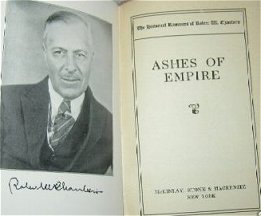
Robert W. Chambers

Robert W. Chambers (1865-1933) was an American artist and
writer. He was born in Brooklyn, New York and is a direct 
descendant of Roger Williams (1603-1683), founder of 
Providence, Rhode Island. Chambers was first an art student 
and an artist, selling sketches to Vogue and Life magazine, 
then decided to dedicate himself to writing. He was a very 
prolific writer and besides odd tales he also wrote romantic 
fiction, historical fiction, and war and war adventure stories 
during WWI. His first novel,'In the Quarter', was written in 
1887 a melodramatic recounting of student life in Paris. His
most famous work is probably the collection of stories known 
as “The King in Yellow” (1895).  It is described as a group of 
eerie short stories. Most of the stories in the book are 
connected by the common theme of a fictitious drama which 
goes by the title- 'The King in Yellow', bad things happen to 
those who read it. His style influenced H.P. Lovecraft and 
others.  His novel 'Tracer of Lost Persons' , a crime drama, was adapted into a long-running radio drama 
                                                          (1937-1954). 

He was a man with many interests, art, history, antiques, 
conservation- as he is known to have planted some 20,000 trees, butterflies, oriental art and he enjoyed 
hunting and fishing. He wrote many historical novels spurred on by his interest in his ancestor, 
Roger Williams. He also wrote about Captain Kidd in his book “The Man They Hung". Sadly he died 
after a failed attempt at surgery to cure an intestinal illness, his brother was the famous architect 
Walter B. Chambers. Chambers was quoted as saying “I write the sort of stories which at the moment
it amuses me to write”, he was a popular author, had more than one best-seller to his name and wrote 
about various subjects, returning now and then to write his weird tales when it suited him. He borrowed
the place Carcosa, from Ambrose Bierce, as the place of his King in Yellow Tales and H.P. Lovecraft 
also used this setting for his Cthulhu stories. 
 
Bibliography of novels and story collections from Wikipedia:

  • In the Quarter (1894)
  • The King in Yellow (1895) – short stories
  • The Red Republic (1895)
  • The Maker of Moons (1896) – short stories
  • A King and A Few Dukes (1896)
  • With the Band (1896)
  • The Mystery of Choice (1897) – short stories
  • Lorraine (1898)
  • Ashes of Empire (1898)
  • The Haunts of Men (1898) – short stories
  • Outsiders (1899)
  • The Cambric Mask (1899)
  • The Conspirators (1899)
  • Cardigan (1901)
  • The Maid-at-Arms (1902)
  • The Maids of Paradise (1903)
  • In Search of the Unknown (1904)
  • A Young Man In a Hurry (1904) – short stories
  • The Reckoning (1905)
  • Iole (1905)
  • The Tracer of Lost Persons (1906)
  • The Fighting Chance (1906)
  • The Tree of Heaven (1907) – short stories
  • The Younger Set (1907)
  • Some Ladies in Haste (1908)
  • The Firing Line (1908)
  • Special Messenger (1909)
  • The Danger Mark (1909)
  • The Green Mouse (1910)
  • Ailsa Paige (1910)
  • The Common Law (1911)
  • The Adventures of a Modest Man (1911)
  • Blue-Bird Weather (1912)
  • The Streets of Ascalon (1912)
  • The Japonette (1912)
  • The Gay Rebellion (1913)
  • The Business of Life (1913)
  • Quick Action (1914)
  • The Hidden Children (1914)
  • Anne's Bridge (1914)
  • Between Friends (1914)
  • Who goes There! (1915)
  • Athalie (1915)
  • Police!!! (1915) – short stories
  • The Girl Philippa (1916)
  • The Better Man (1916) – short stories
  • The Dark Star (1917)
  • The Barbarians (1917)
  • The Laughing Girl (1918)
  • The Restless Sex (1918)
  • The Moonlit Way (1919)
  • In Secret (1919)
  • The Crimson Tide (1919)
  • A Story of Primitive Love (1920)
  • The Slayer of Souls (1920)
  • The Little Red Foot (1920)
  • The Flaming Jewel (1922)
  • The Talkers (1923)
  • Eris (1923)
  • The Hi-Jackers (1923)
  • America; or, The Sacrifice (1924)
  • The Mystery Lady (1925)
  • Marie Halkett (1925)
  • The Man They Hanged (1926)
  • The Drums of Aulone (1927)
  • The Sun Hawk (1928)
  • The Rogue's Moon (1928)
  • The Happy Parrot (1929)
  • The Painted Minx (1930)
  • The Rake and the Hussy (1930)
  • War Paint and Rouge (1931)
  • Gitana (1931)
  • Whistling Cat (1932)
  • Whatever Love Is (1933)

Published posthumously

  • Secret Service Operator 13 (1934) Copyrighted by Elsie M. Chambers
  • The Young Man's Girl (1934) Copyrighted by Elsie M. Chambers
  • The Gold Chase (1935) Copyrighted by Elsie M. Chambers
  • Love and the Lieutenant (1935) Copyrighted by Elsie M. Chambers
  • Beating Wings (1936) Copyrighted by Elsie M. Chambers
  • The Girl In Golden Rags (1936) Copyrighted by Elsie M. Chambers
  • The Fifth Horseman (1937) Copyrighted by Elsie M. Chambers
  • Marie Halkett (1937) Reprint. Copyrighted by Elsie M. Chambers
  • Smoke of Battle (1938) Copyrighted by Elsie M. Chambers; this novel was possibly finished by Rupert Hughes.

Children's books

  • Outdoorland (1902) Illustrated by Reginald Bathurst Birch
  • Orchard-Land (1903) Illustrated by Reginald Bathurst Birch
  • River-Land (1904) Illustrated by Elizabeth S. Green
  • Forest-Land (1905) Illustrated by Emily Benson Knipe
  • Mountain-Land (1906) Illustrated by Frederick Richardson & Walter King Stone
  • Garden-Land (1907) Illustrated by Harrison Cady

Collections containing reprinted work by Robert W. Chambers

  • The Hastur Cycle, edited by Robert M. Price, Chaosium 1993
  • The Yellow Sign and Other Stories, edited by S.T


    Quotes I've assembled from his works:
     
    I awoke to the saddest music I had ever heard. The room was quite dark, I had no idea what time it was. A ray of moonlight silvered one edge of the old spinet, and the polished wood seemed to exhale the sounds as perfume floats above a box of sandal wood.” (The Mask, from The King in Yellow by Robert W. Chambers)

    I left the river side, plunging blindly across to the Champs Elysées and turned toward the Arc. The setting sun was sending its rays along the green sward of the Rond-point: in the full glow he sat on a bench, children and young mothers all about him. He was nothing but a Sunday lounger, like the others, like myself. I said the words almost aloud, and all the while I gazed on the malignant hatred of his face. But he was not looking at me. I crept past and dragged my leaden feet up the Avenue. I knew that every time I met him brought him nearer to the accomplishment of his purpose and my fate. And still I tried to save myself.” (In the Court of the Dragon, from The King in Yellow, by Robert W. Chambers)

    "I could see your face," I resumed, "and it seemed to me to be very sorrowful. Then we passed on and turned into a narrow black lane. Presently the horses stopped. I waited and waited, closing my eyes with fear and impatience, but all was silent as the grave. After what seemed to me hours, I began to feel uncomfortable. A sense that somebody was close to me made me unclose my eyes. Then I saw the white face of the hearse-driver looking at me through the coffin-lid -- " (The Yellow Sign, from The King in Yellow by Robert W. Chambers)
    "For some time I tossed about the bed trying to get the sound of his voice out of my ears, but could not. It filled my head, that muttering sound, like thick oily smoke from a fat- rendering vat or an odor of noisome decay. And as I lay and tossed about, the voice in my ears seemed more distinct, and I began to understand the words he had muttered. They came to me slowly as if I had forgotten them, and at last I could make some sense out of the sounds. It was this:
    "Have you found the Yellow Sign?"
    "Have you found the Yellow Sign?"
    "Have you found the Yellow Sign?"
    I was furious. What did he mean by that? Then with a curse upon him and his I rolled over and went to sleep, but when I awoke later I looked pale and haggard, for I had dreamed the dream of the night before and it troubled me more than I cared to think." (The Yellow Sign, from The King in Yellow by Robert W. Chambers)


    Along the shore the cloud waves break,
    The twin suns sink behind the lake,
    The shadows lengthen
    In Carcosa
    Strange is the night where black stars rise,
    And strange moons circle through the skies,
    But stranger still is
    Lost Carcosa
    Songs that the Hyades shall sing,
    Where flap the tatters of the King,
    Must die unheard in
    Dim Carcosa.
    Song of my soul, my voice is dead,
    Die though, unsung, as tears unshed
    Shall dry and die in
    Lost Carcosa
    Cassilda's Song in "The King in Yellow" Act 1, Scene 2. by Robert W. Chambers
    Books are the blessed chloroform of the mind.
    ” 
    ― Robert W. Chambers Ah," she said, "to come is easy and takes hours; to go is different—and may take centuries.” 
    ― Robert W. Chambers, The King in Yellow